


Introduction: Can African Businesses Be Profitable and Strengthen Their Communities?
The relationship between African business ethics and community flourishing raises a fundamental question about the purpose of enterprise: should a business exist simply to generate returns for its owners, or should it also create value for employees, customers, suppliers, families, and the wider society?
This question is particularly important in African economies, where businesses operate within dense networks of family relationships, community obligations, informal institutions, religious values, and local systems of trust. These relationships can support enterprise, but they can also create challenges when personal loyalty conflicts with professional standards, commercial discipline, or fairness.
African economic traditions offer important resources for thinking about these questions. Ideas associated with Ubuntu, communal responsibility, reciprocity, and stewardship can inform contemporary business ethics. However, these traditions must be critically examined and thoughtfully adapted, not romanticised as if every precolonial community practised perfect economic justice.
The goal is not to replace profitable business with charity. It is to develop enterprises that create value, distribute it responsibly, strengthen institutional capacity, and contribute to the flourishing of the societies that sustain them.
1. What Is the Relationship Between African Business Ethics and Community Flourishing?
African business ethics and community flourishing describe an approach to enterprise in which commercial decisions are evaluated not only by their financial outcomes but also by their effects on human relationships, social trust, institutional integrity, and collective wellbeing.
Business ethics concerns the principles that guide decisions about honesty, fairness, responsibility, transparency, and the use of power. Community flourishing refers to the conditions that enable people and institutions to thrive, including meaningful work, economic opportunity, reliable services, social trust, and the capacity to shape their own futures.
These ideas are connected because businesses do not operate independently of society. They depend on workers who possess skills, customers who trust their promises, suppliers who fulfil their obligations, institutions that enforce agreements, and communities that provide infrastructure and social stability.
When these relationships deteriorate, commercial activity becomes more expensive and less reliable. Businesses may face employee disengagement, supplier disputes, reputational damage, customer distrust, and resistance from affected communities.
Conversely, ethical conduct can strengthen the relationships on which enterprise depends. This does not mean that every community demand must take priority over commercial viability. Businesses must manage costs, compensate risk, generate returns, and invest in future growth. A business that cannot remain financially viable will eventually lose its capacity to employ people or serve customers.
The more useful principle is that profitability and community wellbeing should be designed to reinforce each other wherever possible. An enterprise creates lasting value when it is commercially disciplined, socially responsible, and institutionally trustworthy.
2. What Can African Economic Traditions Teach Modern Businesses?
African societies have never possessed a single, uniform economic philosophy. Economic practices differed across regions, kingdoms, communities, historical periods, and occupations. Nevertheless, many African traditions offer useful insights into the relationship between economic activity and social responsibility.
Ubuntu and the relational nature of enterprise
Ubuntu is commonly associated with the idea that human identity and wellbeing are shaped through relationships with others. Although its expressions differ across African contexts, its ethical significance extends beyond personal kindness.
Applied to enterprise, an Ubuntu-informed perspective asks how business decisions affect the relationships that make economic life possible.
Does an employer develop people or treat them as disposable inputs? Does a company honour its commitments to suppliers? Does a business provide honest information to customers? Does an enterprise use its influence to strengthen or undermine the institutions around it?
An Ubuntu economic model would not necessarily reject private ownership, competition, individual achievement, or profit. Rather, it would challenge the assumption that commercial success can be separated entirely from social responsibility. It would recognise that individual prosperity and collective wellbeing can reinforce each other when people and institutions create conditions for mutual advancement.
Ubuntu, however, should not be reduced to a branding slogan. A company cannot claim to embody communal values while exploiting workers, tolerating corruption, or denying people fair opportunities.
The test is not consistently a business uses the language of community but whether its policies and practices reflect that commitment.
Reciprocity, responsibility, and productive relationships
In many African communities, economic relationships have historically existed alongside social obligations, kinship networks, cooperative practices, and expectations of reciprocity. These arrangements have taken different forms, including collective labour, rotating savings groups, mutual assistance, and community-based resource management.
Their significance lies partly in how they organise cooperation. People contribute time, resources, knowledge, or support because economic life is understood as involving relationships that extend beyond an isolated transaction. Contemporary enterprises can draw from this insight by investing in dependable supplier relationships, sharing knowledge with smaller businesses, developing employees, and creating fair opportunities for local producers.
Yet reciprocity must not become an excuse for favouritism or coercion. A business should not award contracts solely because of family connections, demand unpaid labour in the name of solidarity, or pressure employees to accept unfair treatment because they belong to the same community.
Healthy reciprocity combines mutual responsibility with clear boundaries, fair agreements, and accountability.
Stewardship and the responsibility attached to wealth
Many African moral traditions, including religious and philosophical traditions, connect authority and material resources with obligations to others. In this view, wealth is not merely something to accumulate. It is also a resource to manage responsibly, develop productively, and use in ways that preserve human dignity and strengthen society.
This perspective does not require entrepreneurs to abandon personal prosperity. It asks them to consider what their prosperity makes possible. Can business profits finance better equipment, employee development, new products, and future employment? Can an enterprise build local capabilities that remain useful beyond a single contract? Can successful business owners strengthen institutions that support the next generation of entrepreneurs?
Stewardship turns wealth creation into a question of responsibility: not only how much value is generated, but how wisely it is managed and what it enables others to build.
3. Why Is Relational Trust Important in African Enterprise?
Relational trust is important because business depends on more than formal contracts. It also depends on expectations about whether people will honour their commitments, communicate honestly, and behave reliably when circumstances change.
In many African markets, personal relationships and reputational knowledge play significant roles in connecting buyers, sellers, workers, and suppliers. These networks can help businesses exchange information, establish credibility, and navigate environments where formal systems may be difficult to access. Such relationships can be powerful economic assets.
Consider a small manufacturer that consistently pays suppliers on time, communicates production changes early, and maintains transparent quality standards. Over time, suppliers may become more willing to coordinate deliveries, extend appropriate credit, or collaborate on improvements. That trust can strengthen the manufacturer’s operations while giving suppliers a more dependable commercial partner.
This illustrates the importance of relational market dynamics in African enterprise: economic relationships are shaped by both commercial incentives and social expectations. However, relational trust has limits. Personal connections can exclude newcomers, protect influential individuals from scrutiny, or blur the distinction between professional obligations and private interests. Trust should therefore complement sound institutions, not replace them.
Written contracts, transparent procurement, clear performance standards, accurate records, accessible complaint procedures, and consistent enforcement remain essential. They help ensure that business relationships are fair even when the parties lack personal connections.
The strongest enterprise systems combine the relational strengths of trust and reputation with the reliability of professional standards and accountable institutions.
4. How Can Businesses Pursue Profit While Strengthening Communities?

The practical challenge is to translate ethical commitments into operating decisions. Community flourishing becomes meaningful when it influences how a business hires, purchases, prices, invests, governs, and measures performance.
Five approaches can help.
1. Create decent work and develop capabilities
Employment should be understood as more than a payroll expense. It can be a mechanism for developing skills, building confidence, improving household security, and expanding productive capacity.
Businesses can strengthen this contribution through fair compensation, safe working conditions, transparent promotion criteria, mentorship, and relevant professional development.
For small businesses with limited resources, this need not begin with expensive training programmes. Structured on-the-job learning, documented procedures, peer mentoring, and opportunities to assume greater responsibility can build capability over time.
The objective is to develop people who can contribute meaningfully to the enterprise and carry their skills into the wider economy.
2. Build responsible local supply chains
Purchasing decisions influence which businesses grow, which capabilities are developed, and where economic value accumulates. Where commercially feasible, enterprises can work with local suppliers, artisans, agricultural producers, service providers, and smaller firms. This may help create more reliable supply relationships and strengthen productive networks.
Local procurement should not mean automatically selecting a local supplier regardless of quality, cost, or reliability. It means identifying opportunities to expand local participation while maintaining appropriate standards. Businesses can support this process by communicating requirements clearly, paying invoices within agreed terms, providing useful feedback, and helping suppliers understand quality and compliance expectations.
This approach develops capacity rather than creating permanent dependence.
3. Treat customers with dignity
Ethical enterprise begins with the value promised to customers and the honesty with which that promise is delivered. Businesses strengthen communities when they provide products and services that are safe, fit for purpose, fairly represented, and appropriately priced for the value offered.
Misleading advertising, hidden charges, deliberate product defects, and exploitative sales practices may produce short-term gains, but they weaken trust and impose costs on households.
For businesses serving communities with limited consumer protection, ethical conduct carries particular significance. Customers should not have to sacrifice dignity or informed choice simply because they have fewer alternatives.
4. Reinvest in productive capacity and shared wellbeing
Community contribution should not be limited to occasional donations or public-facing charity campaigns. An enterprise may create more durable benefits by investing in equipment, research, staff development, reliable infrastructure, improved production processes, or partnerships that address clearly identified community needs.
For example, an agricultural processor might improve its cold-storage capacity while creating more dependable purchasing arrangements for farmers. The investment can reduce waste for the business and strengthen market access for producers.
A technology company might train young people in relevant digital skills, recruit qualified participants, and support the development of local professional capacity. In both cases, community benefit is connected to productive activity rather than detached from it.
Philanthropy can still be valuable. The distinction is that donations should complement, not substitute for, responsible employment, fair purchasing, honest products, and sound governance.
5. Make accountability part of business operations
Good intentions are difficult to evaluate without evidence. Businesses should identify the stakeholders most affected by their decisions and establish practical ways to assess their impact. These may include employee retention, workplace safety, supplier payment performance, customer complaints, training outcomes, local procurement, and environmental practices.
Not every small business needs an elaborate sustainability reporting system. A simple, consistent scorecard can provide a useful starting point. The important principle is that leaders should be willing to examine the consequences of their decisions, acknowledge shortcomings, and make corrections.
Community accountability is not merely about being praised by the public. It is about accepting responsibility when business practices cause harm.
5. What Role Should Faith Play in Business Ethics in Africa?
Faith plays an important role in the moral lives of many African communities and can shape how entrepreneurs understand work, wealth, leadership, and responsibility.
For businesses influenced by Christian ethics, for example, work can be understood as participation in meaningful service and productive contribution. Wealth can be treated as a responsibility requiring stewardship, while leadership involves the accountable use of power.
These principles can inform a faith-based business ethics approach in Africa that values honesty, diligence, justice, service, and care for people affected by commercial decisions.
However, ethical leadership requires more than public declarations of faith. Religious identity does not automatically guarantee integrity, just as the absence of religious affiliation does not imply an absence of ethical commitment.
The credibility of faith-informed enterprise rests on observable conduct.
Does the organisation pay workers fairly and on time? Does it honour contracts? Does it resist bribery? Does it treat customers honestly? Does it make decisions transparently and correct wrongdoing when it occurs?
Faith should deepen responsibility, not provide immunity from scrutiny. In diverse workplaces and markets, leaders should also respect the dignity and rights of people who do not share their beliefs. Ethical business practices must be reflected in fair policies and consistent treatment rather than imposed religious conformity.
6. What Are the Risks of Community-Centred Business?
Community-centred enterprise can fail when its ideals are not supported by sound governance and commercial discipline.
One risk is romanticising tradition. Historical communities contained cooperation and mutual obligation, but they also experienced hierarchy, exclusion, conflict, and unequal access to resources. No tradition should be treated as beyond criticism.
Another risk is confusing community loyalty with favouritism. Preferential treatment for relatives or influential associates can undermine merit, discourage capable employees, and expose organisations to corruption.
A third risk is using social responsibility to conceal poor business practices. Donations to community projects cannot compensate for unsafe working conditions, unpaid wages, environmental damage, or dishonest dealings.
A fourth risk is overpromising social benefits without financial sustainability. An enterprise that commits resources it cannot afford may eventually fail, harming employees, customers, suppliers, and the communities it intended to serve.
Finally, businesses can become overly dependent on charismatic founders. If ethical commitments exist only in a leader’s personal intentions, they may disappear when leadership changes.
The response is to combine cultural insight with critical reflection, financial discipline, professional standards, and institutional continuity.
Community flourishing requires enterprises that can do good responsibly, demonstrate results, and sustain their contribution beyond the goodwill of an individual founder.
7. How Can African Businesses Build an Ethical Enterprise Model?
A practical starting point is to treat community flourishing as a design consideration across the business, rather than a separate corporate social responsibility activity.
Leaders can begin with five questions:
- Value creation: What useful problem does the enterprise solve, and for whom?
- Value distribution: How are the benefits, costs, opportunities, and risks shared among owners, employees, suppliers, customers, and other affected groups?
- Stewardship: How does the business use its profits, resources, influence, and knowledge to strengthen future productive capacity?
- Accountability: What standards govern decisions, and how can affected people raise concerns without fear of retaliation?
- Institutional continuity: Will these practices survive growth, financial pressure, and changes in leadership?
These questions can be translated into a simple operating framework.
First, define the enterprise’s commercial purpose and the stakeholders essential to achieving it. Second, establish ethical standards for employment, purchasing, customer relationships, governance, and environmental responsibility. Third, assign responsibility for implementing those standards. Fourth, measure a small set of meaningful indicators. Finally, review the results and adjust the system when evidence reveals gaps.
This process helps prevent ethics from becoming an abstract statement disconnected from daily work. It also creates a bridge between African economic philosophies and contemporary management practice. Ubuntu can inform the understanding of relationships; stewardship can guide the use of resources; reciprocity can shape collaboration; and accountability can ensure that these commitments are translated into fair and measurable practices.
The outcome should be an enterprise that can compete effectively while strengthening the conditions on which wider prosperity depends.
Conclusion: From Private Success to Shared Flourishing
African businesses should pursue profit and serve their communities. Sustainable enterprise requires the capacity to do both.
Profit provides resources for investment, innovation, employment, and continuity. Ethical leadership determines how those resources are generated, managed, and used. Community relationships influence the trust, capabilities, and institutional conditions that enable businesses to thrive.
African economic traditions offer valuable insights into these relationships, but their relevance depends on thoughtful interpretation and practical application. Ubuntu must become more than a slogan. Reciprocity must be protected from favouritism. Stewardship must be reflected in decisions about resources. Faith must be demonstrated through integrity. Community responsibility must be supported by measurable accountability.
For African businesses, the opportunity is to build economic systems that create value, retain and multiply productive capacity, and contribute to wider social wellbeing—without sacrificing commercial discipline or individual initiative.
For us at the Centre for Transformational Leadership, this is fundamentally a question of leadership and nation building. Strong enterprises do more than generate revenue. They develop people, strengthen institutions, cultivate trust, and create conditions in which others can flourish. For CTL, the wider leadership principle is clear: values become transformative when they shape systems, incentives, decisions, and institutional culture.
The ultimate measure of business success is therefore not simply what an enterprise accumulates, but also what it enables people, communities, and future generations to build.
Further Reading – Before the West Worked: Africa’s Ancient and Enduring Wisdom of Work
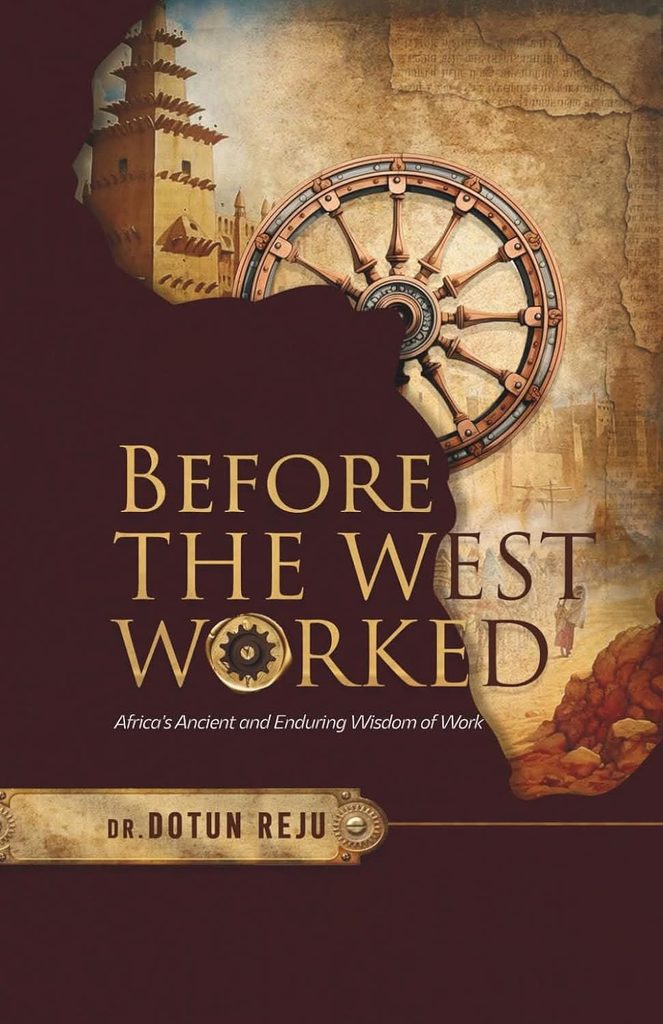
How might African societies’ historical experiences reshape the way we think about work, enterprise, leadership, and collective responsibility today?
In Before the West Worked, Dr. Oladotun Reju invites readers to reconsider familiar narratives about Africa’s past and engage more deeply with the continent’s intellectual heritage, traditions of leadership, and approaches to work and community.
For readers exploring the relationship between African economic values and contemporary enterprise, the book offers a complementary starting point for further reflection.
Explore Before the West Worked by Dr. Oladotun Reju.
Read more about the book and get your copy through the Patris website or Amazon.